 |
 |
Incidents arrive by email, phone, and hallway conversation, nobody can see what is open, and the same problems keep coming back: that is the point at which organizations introduce ITSM. We accompany the entire journey, from the as-is assessment through ITIL-based process design to tool selection, service desk, and ongoing operations. Drawn from projects in industry, banking, healthcare, and the public sector, not from the drawing board.
Without structured service management, requests and incidents bypass any prioritization: there is no overview of what is open, who is working on what, and where the same problems recur. As the organization grows, that becomes a risk. Outages last longer, knowledge lives in individual heads, and IT cannot demonstrate its performance to the business units.
Where ITSM implementations fail in practice almost always follows the same patterns: a tool is bought before the processes are in place. Processes are designed on the drawing board without involving the teams that are supposed to work with them every day. Or an attempt is made to introduce all ITIL practices at once instead of starting with what resolves the biggest bottleneck.
That is why every ITSM implementation with us starts with an honest as-is assessment and with workshops that create transparency between everyone involved and secure acceptance for new processes, before the first tool is evaluated.
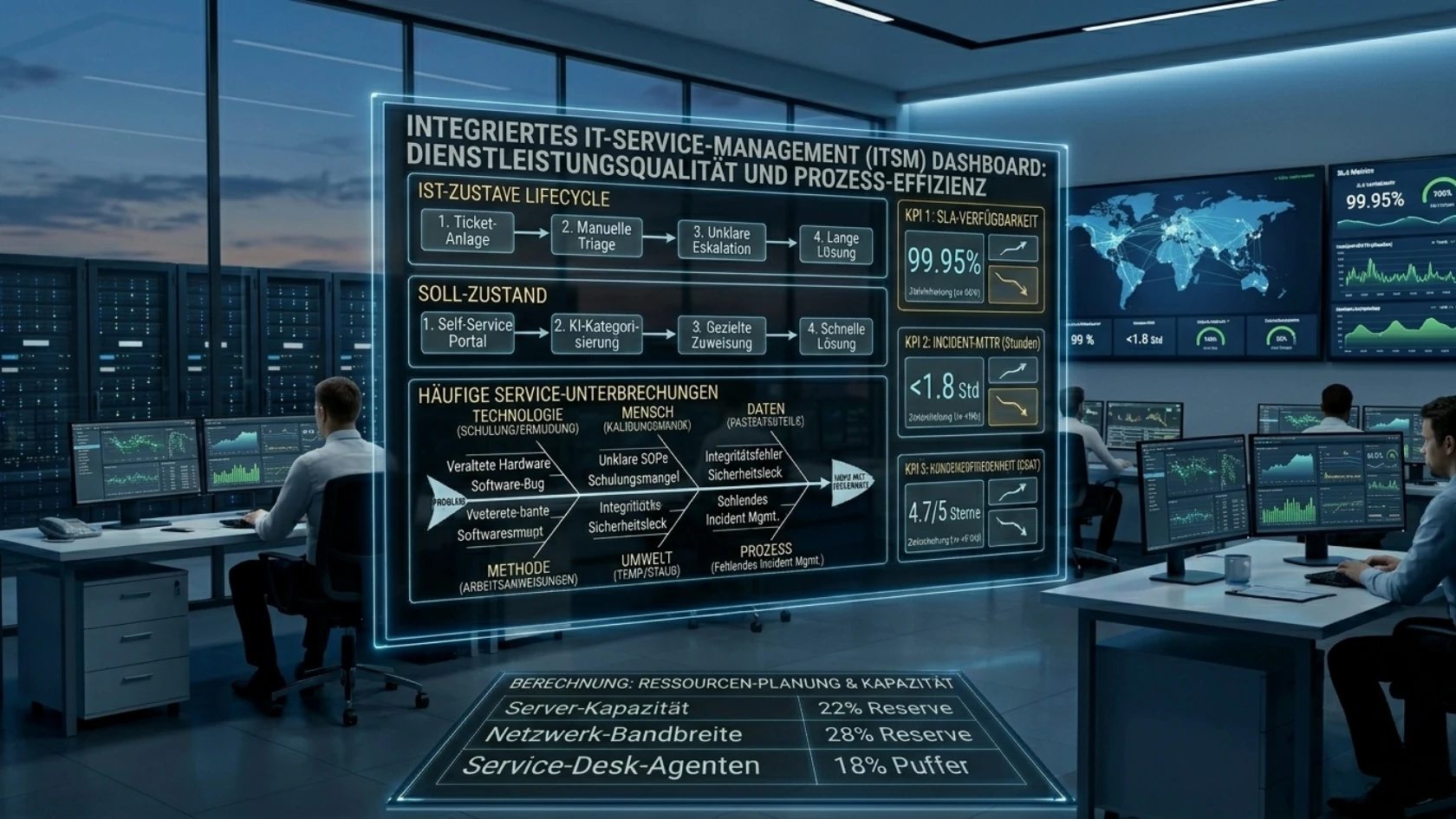
We capture existing IT processes, structures, and responsibilities and identify optimization potential together with business units and IT teams. Functional and non-functional requirements are defined as a solid basis for the ITSM strategy.
Service catalog, SLA definitions, and incident, problem, and change management according to the ITIL standard, adapted to your goals rather than by the book. Workshops and requirement alignment secure the acceptance of everyone involved.
The tool follows the process, not the other way round. We support the selection based on your requirements, the process adaptation, and the integration into your existing IT landscape, including the setup of a central service desk as the single point of contact.
Training for your teams, jointly defined KPIs, and regular reviews: this keeps ITSM from stalling at the state of the rollout and continuously adapts it to new requirements.
We accompany the entire ITSM build-up, from the initial concept phase through implementation to ongoing operations. In concrete terms, that includes:
If IT is to be relieved permanently after the rollout, we also run operations as a managed IT service. An overview of all our services is on the IT services page.
How long an implementation takes depends on the number of practices, the maturity of your current processes, the tool situation, and the time your key people can make available. There are no serious one-size-fits-all figures for that, but there are typical patterns:
A first stage, such as incident management with a central service desk, is typically productive within a few months and already delivers noticeable relief in day-to-day work.
A full build-up with service catalog, SLAs, and several practices is typically an undertaking spanning several months, longer for larger organizations. That is why we work in stages, each stage delivering usable results.
Processes are created with your teams, not for them. Expect regular workshop sessions with your key people. After the as-is assessment you receive a concrete proposal with an effort range before you commit.
ITIL is the established framework for IT service management: a collection of proven practices including incident, problem, change, and configuration management. It gives the implementation structure and a shared language, but it does not replace an honest look at your actual workflows.
That is why we use ITIL as a framework and adapt it to the individual goals of your organization instead of implementing certification doctrine one to one. Your teams do not need an ITIL certification for that: we cover the necessary basics in the training that accompanies the rollout.
What fundamentally distinguishes ITSM from ITIL, and how we approach ITSM in hospitals, is answered in the FAQ below and on our healthcare page.
Have further questions? Feel free to contact us directly via our contact form or by e-mail.
In four steps: an as-is assessment of the existing processes with all stakeholders, ITIL-based process design with a service catalog and SLA definitions, tool selection and rollout including the setup of a central service desk, then operations with training, KPIs, and continuous improvement. The most important principle: processes first, then the tool, and involve the teams from the start.
That depends on the number of practices, the maturity of your current processes, the tool situation, and the time your key people can make available. Typically, a first stage such as incident management with a service desk is productive within a few months, while a full build-up with service catalog, SLAs, and several practices takes considerably longer. That is why we work in stages, each stage delivering usable results.
There is no single right tool: what matters are your processes, the existing IT landscape, and the operating effort. That is why tool selection with us only comes after the as-is assessment and process design, with an evaluation against your functional and non-functional requirements. The tool follows the process, not the other way round.
The effort depends on the scope: the number of practices introduced, the tool situation, integration needs, and the amount of training. We work in stages so that value becomes visible early and you can control the scope. After the as-is assessment you receive a concrete proposal with an effort range before you commit.
ITIL is the established framework for IT service management, and we work with it, but adapted to the goals of your organization rather than by the book. Your teams do not need an ITIL certification: we cover the necessary basics in training so that the new processes are applied with confidence.
Because we accompany the entire journey, from concept through implementation to ongoing operations, with experience from comparable projects in industry, banking, healthcare, and the public sector. With us, processes are created in workshops together with your teams: that creates transparency between everyone involved and secures the acceptance that many implementations otherwise fail on.
ITSM (IT service management) is the discipline: planning, delivering, operating, and improving IT as services. ITIL is a framework for doing that, a collection of proven practices such as incident, problem, and change management. In short: ITSM is the what, ITIL a proven how. ITSM works without ITIL, but in practice ITIL is the shared vocabulary we use and adapt to your goals instead of implementing it by the book.
Yes. In a hospital group we introduced configuration management so that assets and dependencies are transparent, the basis for fast outage analysis and demonstrable IT security under Section 75c SGB V. In a clinical setting we prioritize incidents by their impact on patient care and involve medical technology and ward management from the start. See our healthcare page for details.
In a compact as-is assessment we clarify processes, tools, and the biggest bottleneck, honestly and without selling you a tool.